Industry & Specialist Awards · November 28, 2026
What Should a Workplace Safety Award Recognize? A Buyer’s Guide
Choose workplace safety awards that recognize hazard prevention, worker participation, training, and practical improvements—without creating pressure to hide incidents or near misses.
A workplace safety award should recognize people who help make work safer—not simply a team that has gone a certain number of days without a reported injury.
That distinction matters. A program that celebrates hazard identification, useful near-miss reporting, training, peer support, and follow-through can reinforce the work that helps prevent harm. A program that rewards only a low injury count can create the wrong pressure: people may feel that reporting an injury will cost the team its recognition.
If you are choosing workplace safety awards for a construction company, manufacturer, warehouse, utility, transport operation, or another safety-focused workplace, start with the behavior you want to recognize. The award design and inscription should follow that decision.
This guide explains what to recognize, how to set fair criteria, which approaches to avoid, and what information to prepare before requesting a personalized crystal award.
Start with the purpose of the recognition
Before choosing a trophy, finish this sentence:
“We want to recognize ________ because it helped make work safer by ________.”
A useful answer names an observable contribution. For example, a worker may have identified a recurring hazard, helped improve a procedure, supported a colleague through training, or followed through on a corrective action. A team may have improved a safety walkthrough process or made it easier for colleagues to raise concerns.
If the only answer is “we had no accidents,” pause and reconsider the award criteria. An absence of reported incidents does not, by itself, show whether workers feel comfortable speaking up or whether hazards are being identified and addressed.
The U.S. Occupational Safety and Health Administration (OSHA) encourages employers to use proactive measures alongside measures that record incidents after they occur. Its guidance on leading indicators explains how participation, hazard identification, training, and timely responses can help show whether safety activities are working.
What should a workplace safety award recognize?
A strong program chooses a small number of categories that reflect the work employees actually do. The following examples can help you build a focused set.
1. Identifying hazards and raising concerns
Recognize someone who notices a potential hazard, explains the concern clearly, and helps the responsible team understand what needs attention. The value is not simply that a report was submitted; it is that a concern was raised constructively and could be assessed.
Possible award wording: “For outstanding attention to workplace hazards and a commitment to protecting colleagues.”
2. Reporting near misses and helping prevent a repeat
Near misses can reveal where a process, piece of equipment, work area, or communication step needs attention. Recognition should support honest reporting and thoughtful follow-up—not reward a high raw count of reports.
Consider the quality of the information shared, whether the concern was routed to the right people, and whether the organization learned something useful. Never make an employee or team ineligible because they reported an injury, illness, or near miss.
3. Improving a work practice
A practical suggestion can make a task clearer, reduce exposure to a hazard, improve a handoff, or help colleagues follow a safer procedure. Recognize the contribution when the idea has been reviewed and its value is understood.
Possible award wording: “In recognition of a practical improvement that strengthened our safety practices.”
4. Supporting safety training and peer learning
A colleague who patiently helps others understand a procedure, shares relevant experience, or supports a new team member can make a meaningful contribution. The recognition should be based on specific examples of useful support, not simply on being popular or holding a particular title.
Possible award wording: “For your leadership, guidance, and commitment to helping colleagues work safely.”
5. Completing inspections and following through
A walkthrough or inspection is useful when observations are documented, concerns are communicated, and appropriate follow-up happens. Recognize consistent participation and responsible follow-through rather than treating the number of inspections as a score on its own.
6. Strengthening team coordination
Many safety improvements depend on people coordinating across shifts, departments, contractors, supervisors, and support teams. A team award can recognize clear communication, shared problem-solving, and the way people look out for one another.
For a broader workplace appreciation program, see BCA’s Employee Appreciation Awards. Keep a safety award distinct by naming the safety-related action or improvement being recognized.
Why “zero injuries” should not be the only award criterion
A “days without an accident” milestone may be displayed as one operational measure, but it is a poor stand-alone basis for deciding who deserves recognition.
OSHA states that incentive programs must not be used in a way that penalizes workers for reporting work-related injuries or illnesses. Its recordkeeping and employee-reporting guidance explains that withholding a benefit after an employee reports an injury may amount to retaliation.
OSHA’s Safe + Sound recognition guide advises employers to reward actions that help prevent injuries rather than only the absence of accidents. Examples include reporting hazards and near misses, participating in training and safety meetings, and completing inspections.
In practice, avoid these program designs:
- No award loss after a report: Do not remove an employee or team from consideration because someone reported an injury, illness, hazard, or near miss.
- No pressure to stay silent: Avoid language or contests that make reporting look like failure.
- No raw-count competition: A higher number of reports can reflect greater openness, more opportunities to identify hazards, or a different reporting culture. Review context and follow-through rather than ranking people by report volume.
- No speed-at-any-cost category: Do not celebrate completing work faster if the award criteria ignore whether the work was carried out safely.
- No single metric as the whole story: Use relevant leading indicators and incident data thoughtfully, with input from the people who do the work.
A recognition program is not a substitute for hazard controls, training, supervision, or a functioning safety and health program. It should reinforce those efforts, not replace them. Employers should review program design with their EHS, HR, and legal advisers where appropriate.
Set clear and fair award criteria
Write the criteria before inviting nominations. This makes the process easier to explain and reduces the risk that recognition becomes a popularity contest.
For each category, define:
- Who is eligible: Individual employees, teams, supervisors, contractors, or more than one group.
- What behavior counts: Describe the action in plain language.
- What evidence is useful: A specific example, improvement record, training contribution, inspection follow-up, or documented team practice.
- Who reviews nominations: Identify the people responsible and how conflicts of interest will be handled.
- How the decision is communicated: Explain what the recipient did and why it mattered.
- How reporting rights are protected: Make clear that reporting an injury, illness, hazard, or near miss will not disqualify someone.
Use criteria that fit the role. A warehouse employee, maintenance technician, site supervisor, driver, and office-based safety coordinator may contribute in different ways. Fair recognition does not require identical measures for every job; it requires clear, relevant standards and a genuine opportunity for different roles to be seen.
OSHA’s recommended practices for safety and health programs emphasize worker participation and a proactive approach to finding and correcting hazards. Involve workers when deciding what the program should recognize. They can often identify contributions that managers do not see from a desk or report.
Individual award or team award?
Choose the recipient format based on how the contribution happened.
Recognize an individual
An individual award is appropriate when one person's action or sustained contribution can be described clearly. Use the recipient's preferred name and, if relevant, their department or role. Explain the action rather than relying on a generic title such as “Safety Champion.”
Recognize a team
A team award can be more accurate when an improvement depended on shared planning, communication, or consistent practice. Confirm the official team name and decide whether the award will be displayed by a department, worksite, or central office.
Recognize a cross-functional contribution
Some improvements involve operations, maintenance, training, procurement, and safety staff. If the work crossed departments, decide whether one shared award or a coordinated set is the fairest way to record the contribution.
For a project-specific presentation, BCA’s construction project completion award guide covers how to identify the milestone and recipient group without overstating who contributed.
Choose an award design that supports the message
A safety award does not need to look like a hard hat to be meaningful. The right design depends on the workplace, the recipient, the presentation setting, and the achievement.
Consider three broad directions:
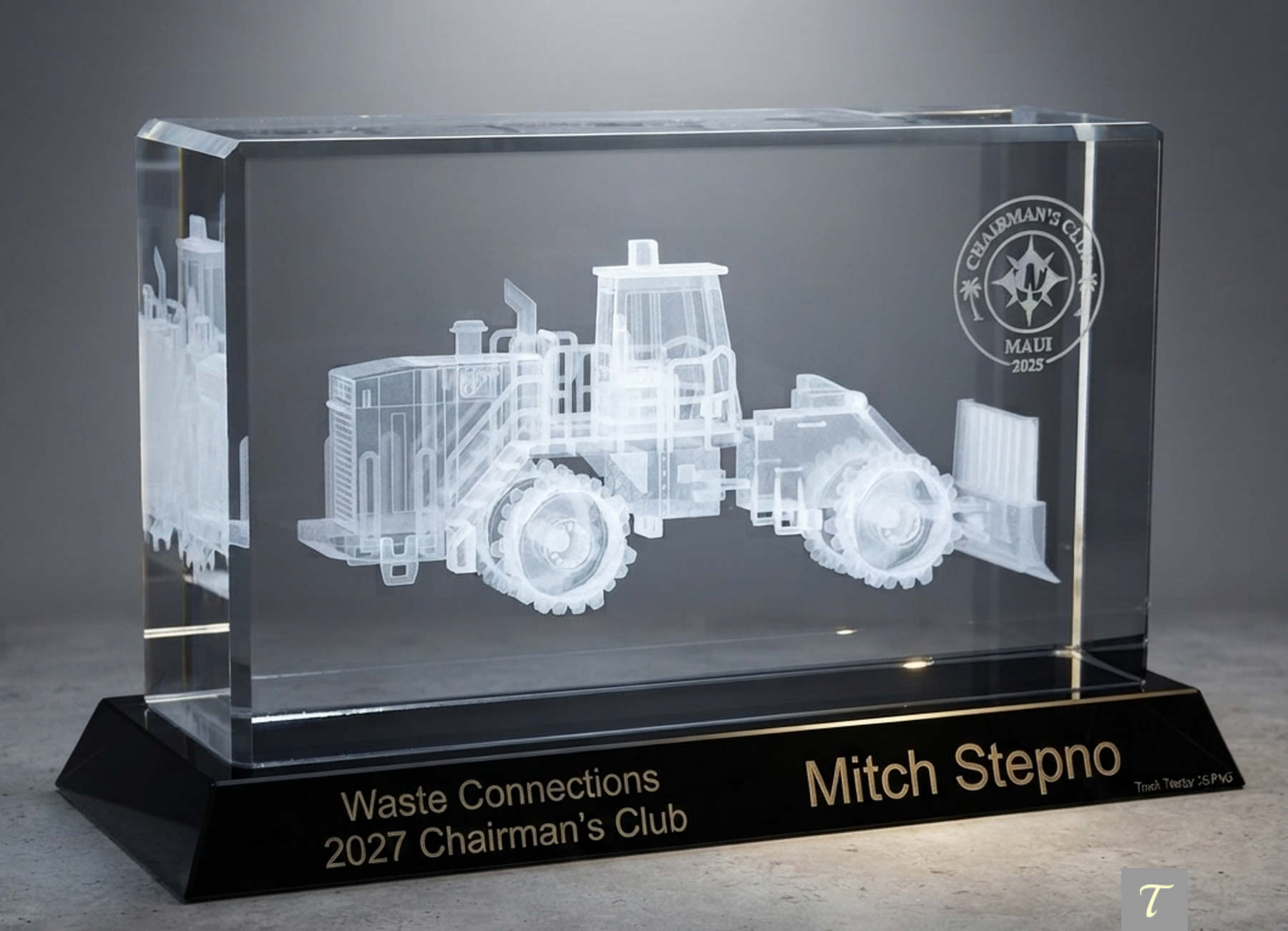
- A recognizable industry motif: An object connected to the work can make the award immediately relevant. BCA’s existing tractor crystal design is an example of an industry-specific motif for equipment-related recognition; it should not be presented as a certified safety product or a dedicated hard-hat award.
- A clear geometric form: A classic crystal shape can suit a formal annual recognition event, especially when the inscription carries the specific safety message.
- A custom concept: If a shield, protective symbol, machine component, or workplace-specific reference is important, share a sketch or reference image through BCA’s Custom Crystal Awards page. A proposed concept must be reviewed for feasibility before it is treated as an available design.
Best Crystal Awards describes its work as factory-direct crystal production. Peter Johansson has operated his own production facility for more than 30 years and personally trained the artisans. Awards are individually produced, engraved, and inspected. The company also states that it has no minimum order requirement. These are the production facts to use when evaluating the supplier; confirm the selected design and its specific details before placing an order.
What should the inscription say?
Keep the message short enough to read comfortably. A useful inscription normally includes the award title, recipient or team name, the specific contribution, the organization, and the presentation year where relevant.
Examples to adapt:
Hazard Prevention Recognition
“Presented to [Name]
For identifying a workplace hazard and helping the team take action
[Company] · [Year]”
Safety Improvement Award
“In recognition of your practical contribution to improving our work practices
[Company] · [Year]”
Peer Safety Leadership
“For looking out for colleagues and helping make safe work a shared responsibility
[Company] · [Year]”
Safety Training and Mentorship
“With appreciation for your guidance, knowledge-sharing, and support of safer work
[Company] · [Year]”
Team Safety Contribution
“Presented to [Team Name]
In recognition of collaboration and meaningful contributions to safer work
[Site or Department] · [Year]”
Avoid wording such as “perfect safety record” if it could imply that reporting incidents is undesirable. The award should describe the positive contribution, not suggest that workers should remain silent.
Prepare the order brief before requesting a quote
A clear brief helps the supplier understand the occasion and the personalization requirements. Gather:
- The award category and the behavior or improvement being recognized.
- Individual recipient names or the approved team name.
- The exact inscription, including capitalization and punctuation.
- The company logo and any brand guidelines.
- The quantity and whether each award needs different wording.
- The presentation date and delivery destination.
- A reference image or sketch if you want an industry-specific or custom motif.
- The person responsible for reviewing and approving the final artwork.
Use one checked recipient list as the source of truth. Have the responsible person verify every name, title, date, and line of text before approving the final proof. For more general preparation, see BCA’s crystal award quote comparison checklist.
Helpful answers
Frequently asked questions
Should a safety award be based on zero workplace injuries?
No. A zero-injury measure should not be the sole basis for recognition. OSHA warns against incentive programs that penalize or discourage employees from reporting work-related injuries or illnesses. Recognize proactive actions such as hazard identification, training, participation, and follow-through.
Can employees be recognized for reporting a near miss?
Yes, when the recognition supports open reporting and learning. Consider the usefulness of the information and the response to the concern, not just the number of reports. Make sure employees are not discouraged from reporting injuries or hazards.
What are examples of workplace safety award categories?
Possible categories include hazard identification, safety improvement, peer mentoring, training participation, inspection follow-through, and team coordination. Choose categories that reflect the work and risks in your organization.
Should safety awards be individual or team-based?
Use an individual award when a person's contribution is clear. Use a team award when the result depended on shared effort. A program can include both, provided the criteria are transparent.
What should be engraved on a safety award?
Include the award title, recipient or team name, a concise description of the contribution, the organization, and the year if useful. Avoid language that rewards silence or implies that reporting an incident is a failure.
Can a crystal award be customized for a safety program?
BCA offers custom crystal award design discussions. Share the safety theme, reference image, logo, wording, quantity, and required date. The specific concept, personalization method, and production details must be reviewed and confirmed before ordering.
What should I send when requesting a safety award quote?
Provide the quantity, recipient list, exact wording, logo, preferred design or reference image, presentation date, and delivery destination. Identify whether the award is for an individual, team, or department and explain the contribution being recognized.
Made for meaningful recognition
Ready to make an achievement memorable?
Share your event, design direction and timeline. Our team can help you explore a fitting crystal award.
Discuss your award project →