Custom Crystal Awards · October 25, 2026
Deep Etching vs. Sub-Surface Laser Engraving for Custom Crystal Awards
Compare deep etching and sub-surface laser engraving for custom crystal awards. Learn how each technique affects appearance, personalization, and design.
By Peter Johansson
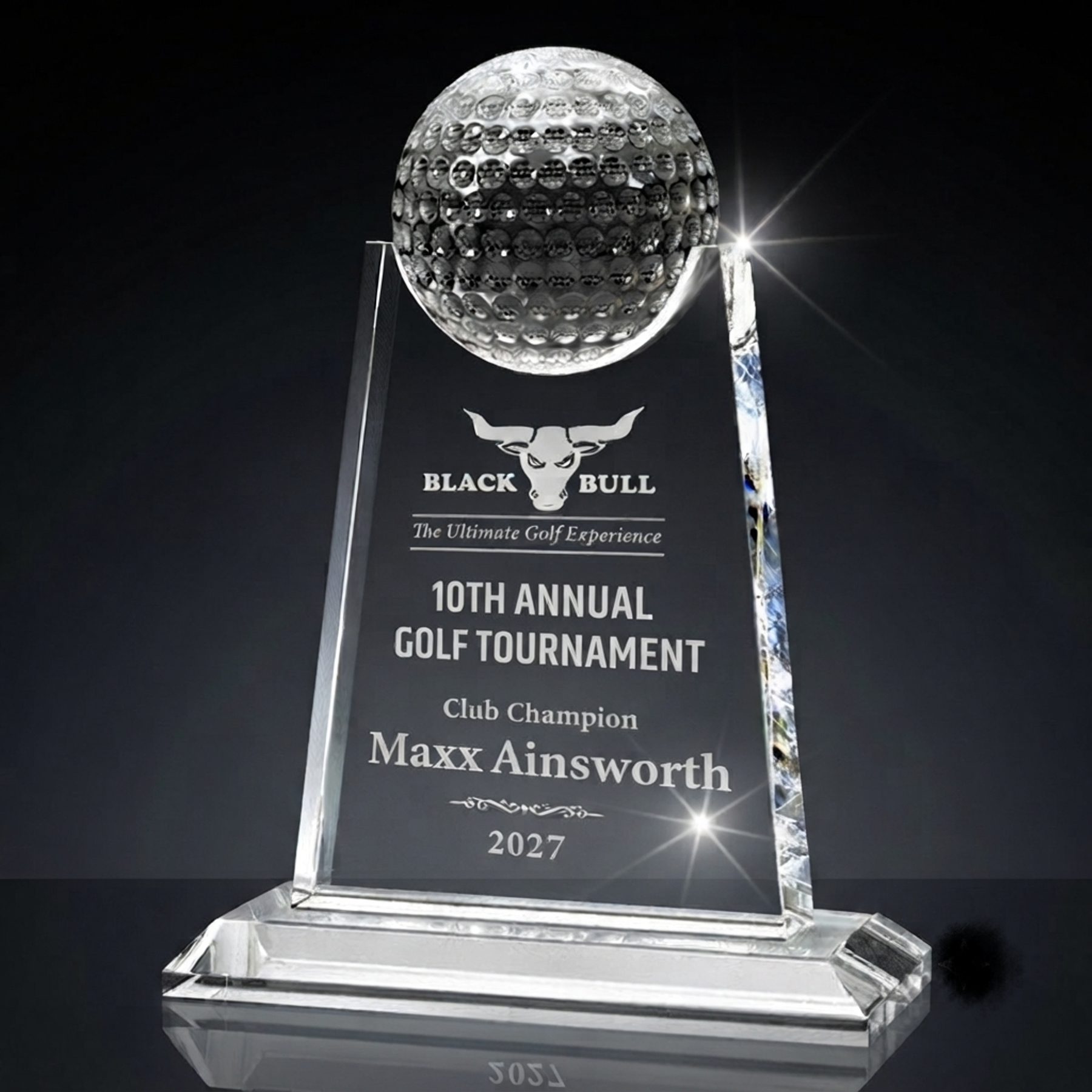
When choosing a custom crystal award, the design is only part of the decision. The way a logo, inscription, or commemorative detail is engraved can influence the finished appearance.
I have come to appreciate how much personalization contributes to the meaning of an award. A suitable engraving technique should complement the design, keep the message readable, and fit the type of recognition being presented.
Two techniques worth understanding are deep etching and sub-surface laser engraving. They create different visual effects and are not interchangeable in every application. In this guide, I’ll explain the differences and what to consider before approving your award design.
What Is Deep Etching on Crystal Awards?
Deep etching creates a recessed design in the surface of a material. On crystal awards, this commonly involves abrasive etching or sandcarving, where controlled abrasion removes material from selected areas.
The result is a design you can see and feel on the crystal surface. Depending on the process and artwork, the engraved area may appear frosted or matte against the surrounding clear material.
Deep etching can suit designs that benefit from defined surface treatment, including lettering, logos, and decorative elements. The result depends on the crystal, the detail in the design, and the engraving process used.
What makes deep etching distinctive?
- Surface definition: The design is created on the exterior of the crystal.
- Tactile detail: The engraved area may have a noticeable texture.
- Frosted appearance: Abraded areas can contrast with the clear surrounding surface.
- Design flexibility: Fine lines and small lettering need to be assessed at the actual production size.
Deep etching is not one universal production method. Ask the supplier whether the proposed technique uses abrasive etching, sandcarving, or another surface-engraving process.
What Is Sub-Surface Laser Engraving?
Sub-surface laser engraving creates small, controlled points within the interior of suitable crystal or glass. Those points form a design that can appear suspended inside the material.
Unlike surface etching, the intended image is formed within the crystal rather than as a recessed design on the outside. This can allow certain designs to create a three-dimensional effect when viewed from different angles.
Depending on the equipment, crystal characteristics, and artwork, sub-surface laser engraving may be used for names, logos, symbols, and selected three-dimensional designs.
What makes sub-surface laser engraving distinctive?
- Internal placement: The engraved pattern sits inside the material.
- Three-dimensional potential: Multiple points or layers can create depth.
- Clear outer surface: The image is formed internally rather than through conventional surface abrasion.
- Artwork preparation: The final appearance depends on how the artwork is prepared for the equipment.
Not every logo or image automatically translates into a strong internal engraving. Fine details, contrast, proportions, and viewing angle all matter. For complex artwork or very small text, review a production-ready proof or representative sample before committing to a large order.
Deep Etching vs. Sub-Surface Laser Engraving: What Is the Difference?
| Consideration | Deep etching | Sub-surface laser engraving |
|---|---|---|
| Where the design is formed | On the crystal surface | Within the crystal |
| Typical visual effect | Recessed or frosted detail | Internal points that form an image |
| Texture | The etched area may be tactile | The internal image itself does not etch the exterior |
| Design possibilities | Surface lettering, logos, and decorative detail | Internal images, logos, and selected dimensional designs |
| Key design consideration | Etching detail and legibility | Internal contrast, point density, and viewing angle |
Neither method is automatically superior. The right choice depends on what the award needs to communicate and how the recipient will see and display it.
Which Technique Is Better for a Company Logo?
A company logo needs to remain recognizable at the actual size of the finished award. Logos often contain small lettering, narrow lines, or fine shapes that require careful preparation for engraving.
For deep etching, consider how the logo will translate into a surface treatment. Simple shapes and clearly separated elements may work well, while extremely fine details may need adjustment.
For sub-surface laser engraving, consider how the internal image will appear through the crystal. The logo may need to be simplified, resized, or prepared specifically for the equipment.
Before choosing a method, ask:
- Can the logo be reproduced clearly at the proposed size?
- Will small text remain readable?
- Does the technique suit the logo’s fine lines and shapes?
- Can the supplier show a comparable example?
- Will the final proof represent the intended production method?
If brand consistency matters across a collection of awards, request the same approved artwork treatment for each piece wherever the production method allows.
Which Technique Is Better for Names and Inscriptions?
For personalized awards, the engraving technique should support the message rather than compete with it. Recipient names, achievement titles, dates, and company names need a clear visual hierarchy.
When evaluating a design, pay attention to font size, line spacing, the amount of text, the relationship between the inscription and logo, the available engraving area, and how the design will look under typical lighting.
Long inscriptions may require shorter wording or a different layout. If several awards will have different names and achievements, confirm that the template can accommodate those variations without compromising readability.
Proofread every name and date before production. Reviewing the inscription carefully is one of the simplest ways to avoid preventable personalization errors.
Can Both Techniques Be Used in the Same Award?
Some award designs can combine different personalization methods, but compatibility depends on the material, design, available equipment, and production process. Whether a combination is practical should be confirmed with the manufacturer rather than assumed.
If you are considering a mixed technique, ask which elements will be engraved internally and which will be placed on the surface, whether the combination suits the selected award, how the elements will align, and whether the final proof shows the intended result. Confirm any impact on the quote or production schedule.
What About Cost and Production Time?
There is no reliable universal rule that one technique is always cheaper or faster. Pricing and lead times depend on the award, quantity, design complexity, artwork preparation, equipment, and production workflow.
When requesting a quote, provide the award model or approximate dimensions, required quantity, logo and inscription, artwork requirements, event date, and packaging or delivery needs. Ask the supplier to identify any artwork preparation, setup, proofing, or additional production costs.
This makes it easier to compare options accurately rather than comparing base prices that may not include the same services.
Your Engraving Proof Checklist
Before approving a custom crystal award, check the following:
- The recipient’s name is spelled correctly.
- The award title and achievement are accurate.
- Company names, dates, and event details are correct.
- The logo is the correct version.
- The engraving technique matches the intended appearance.
- Small text and fine details remain legible.
- Text and logo are positioned correctly.
- The design fits the dimensions of the selected award.
- The supplier has confirmed the production method and timeline.
- The final proof has been approved by the appropriate person.
For bulk orders, consolidate recipient information into one verified list and designate one person to approve the final proof. This helps keep the process organized and reduces avoidable revisions.
Choosing the Right Engraving for Your Crystal Award
Deep etching and sub-surface laser engraving can both be effective ways to personalize crystal awards, but they produce different results. Deep etching creates surface-defined detail, while sub-surface laser engraving forms an image within the crystal.
Begin with the message you want the award to communicate, then choose the technique that best supports the design, logo, inscription, and presentation.
If you are comparing options, explore our Custom Crystal Awards collection. Consider the design you want, prepare your personalization details, and discuss available engraving options before approving production.
A thoughtful combination of design and personalization can turn a crystal award into a meaningful record of achievement.
Made for meaningful recognition
Ready to make an achievement memorable?
Explore custom crystal award options and talk with our team about your event, design, and timeline.
Explore Custom Crystal Awards